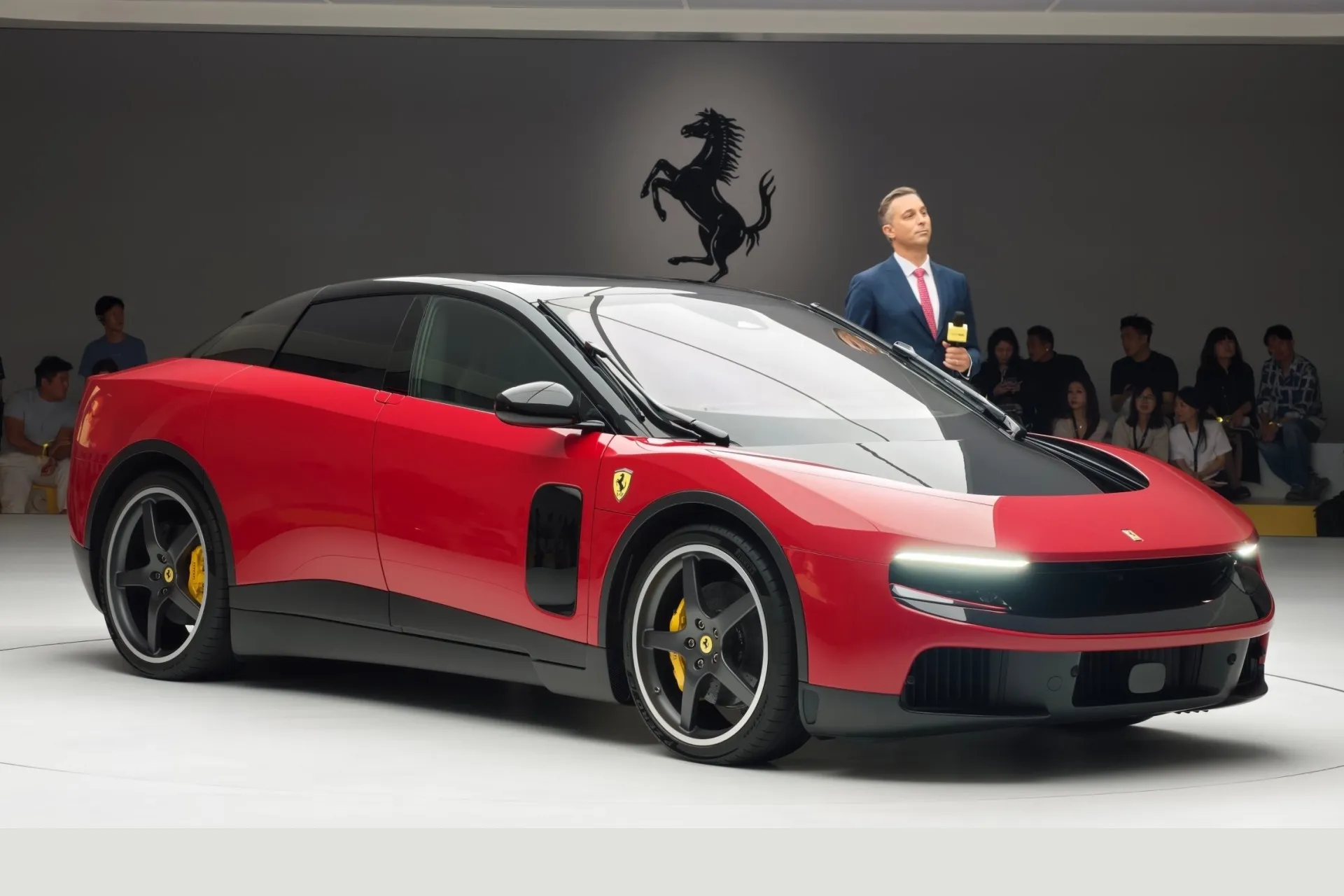
In May 2026, Ferrari unveiled the most important car of its decade in Rome: the Luce, the brand’s first fully electric model, designed with Jony Ive, Apple’s former design chief. The reaction was a disaster. Online, the car became a meme. A former chairman suggested taking the prancing horse off the hood. Italy’s deputy prime minister said it didn’t look like a Ferrari. And the stock fell more than 8% in a single session.
By November, the same car was sold out for all of 2027.
Both things are true. And the space between them is what matters to any company thinking about change.
What happened
The facts, in order.
- May 25: Ferrari reveals the Luce at a closed event for about 200 journalists, according to Harvard Business School professor Stefan Thomke, writing in HBR today. The car has four doors, five seats and a starting price of €550,000. Its design, created with LoveFrom, the studio of Ive and Marc Newson, breaks with the brand’s classic lines.
- The next day: shares drop 8.4%, according to HBR. Thomke notes that the stock recovered in about a week.
- June: Ferrari announces the departure of Enrico Galliera, its chief marketing and commercial officer for more than 16 years. According to Euronews, the company denies any link to the criticism and says the exit had long been agreed. His successor, Massimiliano Di Silvestre, comes from BMW Italy, a rare move for a company that almost never hires from rivals.
- July: TNW reports that the 2026 allocation of roughly 500 cars sold out in under two months. Ferrari did not comment on the figure.
- November 3: presenting third-quarter results, CEO Benedetto Vigna says the Luce’s 2027 production is “fully allocated.” According to TechCrunch, anyone ordering one today will wait about a year. The same day, the company reported quarterly net profit of €431 million, up 13%, and raised its full-year outlook, per Il Sole 24 Ore.
Ferrari does not disclose how many Luces it plans to build. TechCrunch cites a Financial Times report, based on unnamed sources, putting the target at just under 500 units this year and 2,500 by 2030. First deliveries start now, in the fourth quarter, and customer test drives only in 2027. In other words, the story isn’t over. But the first chapter already teaches a lot.
5 curious facts about the Luce
If all you have seen are the photos and the memes, the car itself is worth a closer look. These facts were gathered by the Brazilian outlet Canaltech.
- A Ferrari with an Apple accent. The design is by Jony Ive, Apple’s former design chief. Canaltech even asks whether this is the long-rumored “Apple Car”.
- One motor per wheel. There are four electric motors, with a combined 1,050 hp.
- No-frills cabin. Despite the price tag, the interior is minimalist and full of physical buttons, against the screen-heavy trend in new cars.
- A family sports car. Unlike almost every sports car, the Luce seats up to five, thanks to a 2.96-meter wheelbase.
- A V12 flavor. An acoustic system amplifies the real sound of the electric motors to give the driver something close to a V12 roar. A clear nod to the purists.
Source: Canaltech, Paulo Amaral
Reading 1: noise is not demand
The people laughing at the Luce online were never going to buy a €550,000 car. The people who were going to buy it, bought it. Ferrari didn’t need to please the crowd. It needed to convince a few hundred people around the world, and it did.
This is the most common mistake we see in mid-sized companies: treating the opinion of those who comment as if it were the opinion of those who pay. A negative post, a remark from a long-time partner, a frown from a director. It all weighs on you, but it rarely represents the buyer. The right question is never “did they like it?” It is “did the people who had to buy, buy?”
Reading 2: scarcity buys room for error
Ferrari has an advantage few companies have: it decides how much it sells. With small volumes and a waiting list, a controversial launch doesn’t have to win the market. It only has to fill an allocation.
The quarter’s results make the point. According to TechCrunch, personalization accounted for more than 21% of revenue from cars and spare parts. Ferrari doesn’t make money by selling more cars. It makes money by selling fewer, pricier, more personalized ones. According to Il Sole 24 Ore, it delivered 3,368 cars in the quarter, 33 fewer than a year earlier, and profit still grew by double digits.
For a mid-sized company, the translation is direct: when you control supply, you also control the risk of innovating.
Reading 3: the essence doesn’t live in the form
Thomke’s HBR piece uses the Luce to ask an uncomfortable question: what makes a company unique, and how can it evolve without losing that? His provocation is that this essence lies neither in the mission statement nor in the visual identity.
Our reading at TBS GROUP points the same way. A Ferrari customer isn’t buying the curve of a hood. They’re buying exclusivity, performance, membership in a small club. When change preserves what the customer values, it can break with almost everything else, including the aesthetics fans consider sacred.
The reverse is also true. Many brands change their logo, color and tagline while keeping intact the very thing customers dislike. They change the packaging, not the promise.
Reading 4: change costs you now, and pays you later
The stock drop was immediate. Confirmation of demand took five months. That mismatch is normal, and it is exactly why so many companies give up halfway.
The marketing change deserves a careful look. Ferrari says Galliera’s exit was planned, and we have no grounds to say otherwise. But the episode shows how quickly short-term pressure reaches the decision makers. If a company doesn’t agree in advance on the metric that will judge the change, the next day’s headline does the judging.
Reading 5: bringing in an outsider has a cost, and sometimes it pays
Ferrari brought in the most famous designer in tech to draw a car. By definition, that unsettles insiders. The result looks strange to the longtime fan because it was made for a customer who may not be the usual one.
Vigna said, according to TechCrunch, that there is no specific profile of Luce buyers. It’s too early to know whether the car brought new people to the brand. But the bet makes sense: a company that wants to grow must, at some point, design for tomorrow’s customer, not only yesterday’s.
What to do on Monday
- Separate fans from customers. Before any change to brand, product or positioning, define which buyer must approve it. Test with them, not with the leadership group chat.
- Write down what’s non-negotiable. Make a short list of what customers really pay for: lead time, trust, technical support, provenance. Change the rest with more courage.
- Agree on the yardstick before launch. Pick two or three indicators (orders, proposals, repeat purchases, margin) and a deadline to evaluate them. Social media reaction is a thermometer, not a verdict.
- Make scarcity work for you. Limited batches, pre-sales, waiting lists. It works in manufacturing, agribusiness, healthcare and services, not just luxury. Controlled volume lowers the risk of innovating.
- Prepare your first-week response. Every meaningful change causes discomfort. Have the reasoning, the behind-the-scenes story and the voice of early buyers ready.
- Don’t fire the strategy in the heat of the moment. Backing down within 48 hours because of criticism usually costs more than the criticism.
Ferrari still has to prove the Luce delivers on the road what it promised on paper. But one lesson is already clear: a strong brand isn’t the one everyone likes. It’s the one that knows exactly who it’s talking to.